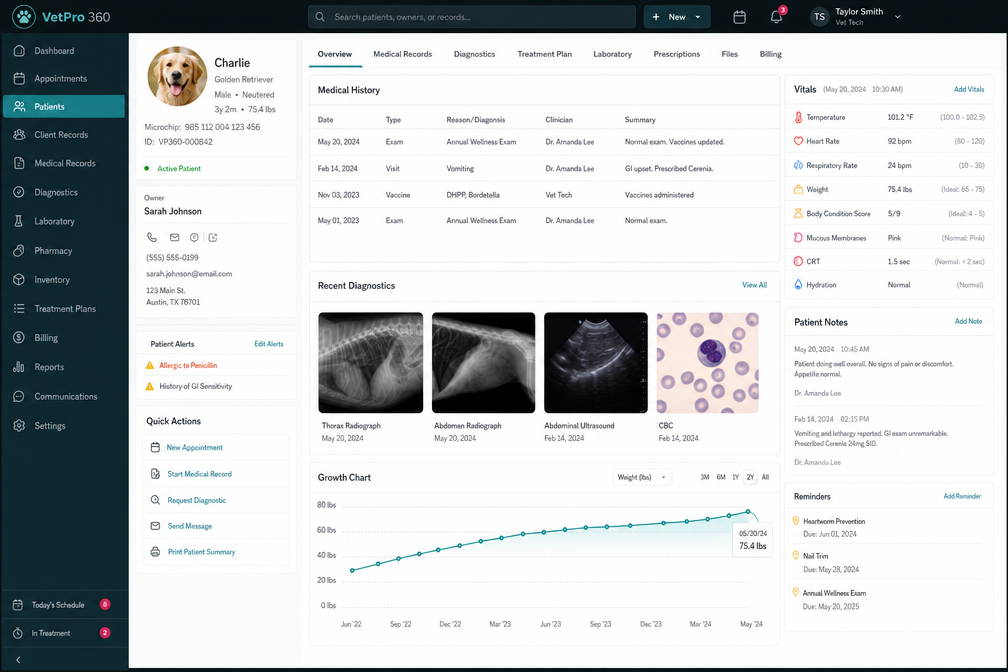
Vet tech software connects every piece of a clinic’s daily operation into one system. Appointment scheduling, technician charting, patient records, billing, and client messaging sit under one roof once a practice picks the right platform. You already know the cost of separate tools for every task. A connected system removes that friction and hands your team real time back with patients.
The market moved fast over the past two years. Analysts value the global veterinary software market at $1.44 billion in 2024, with a climb to $3.01 billion projected by 2030 at a 12.6% annual growth rate.<cite index=”7-1″>The global veterinary software market size was estimated at USD 1.44 billion in 2024 and is projected to reach USD 3.01 billion by 2030, growing at a compound annual growth rate of 12.6% from 2025 to 2030.</cite> North America holds the largest regional share, close to 43% of that total.<cite index=”7-1″>North America veterinary software market held largest share of 42.97% of the global market in 2024.</cite> Growth at that pace signals one clear shift: clinics are leaving paper charts and phone-tag scheduling behind for good.
This guide breaks down the vet tech software market and answers the questions clinic owners and technicians ask most often. Which platforms handle deep clinical documentation? Which ones solve missed appointments? Which tools overlap, and which ones belong together? A full comparison follows, built around real clinic workflows, current market data, and the mistakes that cost clinics money.
What Is Vet Tech Software?
Vet tech software supports technician-facing visit documentation, appointment coordination, and ongoing patient record tracking. Structured records tie directly to appointments and pet profiles, so nothing slips through the cracks between visits. Built-in reminders, two-way messaging, and task-status visibility keep follow-up care on track without extra phone calls.
Two clinics rarely need the exact same setup. A single-doctor general practice cares about different things than a five-location emergency group. Kareo Clinical and Cornerstone Animal Hospital Software sit at the tech-focused end of the spectrum, and both combine clinical documentation with appointment-linked workflows in one system. Ask yourself a simple question before you compare vendors: does your team need deep charting first, faster scheduling first, or better client communication first?
Which Features Actually Matter in Vet Tech Software?
Feature lists look similar across vendor websites. Real differences only show up once your technicians run a full shift on the software.
Does the Software Link Charting to Appointments?
Appointment-linked charting keeps active cases easy to find. Cornerstone Animal Hospital Software and ClinicSense both tie patient records to the visit in progress, and that link shortens the time technicians spend hunting for the right chart. Kareo Clinical goes a step further and merges scheduling and charting into one centralized workflow.
Do Visit Templates Stay Structured?
Structured templates cut down on variation between technicians and clinicians. Kareo Clinical stands out here, with templates built for fast, consistent documentation across every visit type.
Can Your Team Track Tasks Tied to Each Visit?
Multi-step care plans need visible status updates. Vetspire builds task tracking directly into each visit, and Kareo Clinical pairs tasking with full record management for coordinated documentation.
How Fast Can Techs Search Patient Records?
A busy shift leaves no room for slow record lookups. Vetspire focuses on searchable medical records built for quick retrieval, and Kareo Clinical offers deep record management that spans visit notes and full medical history.
Do Clients Get Two-Way Confirmations?
No-shows cost clinics real money. Practices lose between 12% and 20% of booked appointments to no-shows and last-minute cancellations each year, according to the American Veterinary Medical Association.<cite index=”17-1″>According to the American Veterinary Medical Association (AVMA), veterinary practices lose between 12% and 20% of all booked appointments to no-shows and last-minute cancellations each year.</cite> Clinics without a structured reminder system typically land between 9% and 11%, well above the 5% benchmark that well-run practices target.<cite index=”12-1″>A well-managed practice should aim for a no-show rate below 5 percent. Most clinics without structured reminder systems sit between 9 and 11 percent.</cite> Automated, two-way reminders change that math directly: clinics that switch from manual calls to automated systems report a 30% to 50% drop in no-shows.<cite index=”11-1″>Clinics using automated reminders report a 30–50% reduction in no-shows.</cite> Demandforce supports two-way scheduling with automated reminders and confirmations, and Podium for Healthcare adds two-way SMS confirmations and reschedules on top of that.
Does Online Booking Include Intake Forms?
Front-desk delays start before a client even walks in the door. Acuity Scheduling offers custom availability rules, buffer times, and intake-style forms that capture visit details before arrival. A clinic that already runs a full medical record system elsewhere can use Acuity as a scheduling backbone without a duplicate charting layer.
Can AI Scribes Cut Down Manual Notes?
AI-powered ambient scribing changed fast over the past year. PetDesk released PetDesk Scribe in March 2025, an AI transcription tool built to help veterinarians skip manual note-taking during exams.<cite index=”5-1″>In March 2025, PetDesk launched PetDesk Scribe, an AI-powered transcription tool designed to help veterinarians focus on patient care by eliminating manual note-taking.</cite> Tools like CoVet, VetRec, and HappyDoc listen during the appointment and draft SOAP notes on their own, so your technicians stay focused on the pet and the owner instead of the keyboard.
How Do You Choose the Right Vet Tech Software for Your Clinic?
Five checkpoints separate a good decision from a costly one.
Start with charting depth. Clinics that handle varied, complex cases need structured templates and deep visit notes. Kareo Clinical combines both with tasking and medical history in one workflow. Cornerstone Animal Hospital Software and ClinicSense also link charting to appointments, though Cornerstone’s charting screens can feel dense for fast technician documentation, and ClinicSense sometimes adds extra clicks during a packed shift.
Check appointment-to-visit linkage next. Technician time disappears fast when records sit apart from the visit in progress. Cornerstone links documentation directly to appointments. ClinicSense ties scheduling to patient workflows and follow-ups. Kareo Clinical cuts down on handoffs between clinicians and techs through connected scheduling and tasking.
Match communication automation to your biggest pain point. Missed visits and manual confirmation calls drain staff time fast. Demandforce and Podium for Healthcare both center on two-way scheduling, reminders, and confirmations. PetDesk drives reminders and owner messaging from inside each pet’s profile.
Use scheduling-only tools only when records live elsewhere. Acuity Scheduling works well as a booking and intake layer for clinics that already run a full record system. A scheduling tool alone never replaces a proper EHR-style charting workflow.
Confirm whether outside services need separate coordination. Boarding, drop-in visits, and sitter coordination fall outside clinical documentation entirely. Rover supports marketplace-style booking with in-chat communication tied to specific pets and services, but internal case tracking still needs a dedicated clinical tool. Vetspire centers on insurance claims workflows alongside organized visits and task tracking, a strong fit for clinics that handle a high volume of insured patients.
Which Clinics Need Which Type of Vet Tech Software?
Your clinic’s biggest bottleneck points straight to the right category.
Clinics that need integrated documentation, scheduling, and reporting fit best with Kareo Clinical. Structured templates, medical history, tasking, and billing-oriented charting live in one connected workflow, and built-in reporting shows documentation coverage across patients and dates.
Animal hospitals that want technician-friendly charting tied to appointments should look at Cornerstone Animal Hospital Software and ClinicSense. Reminders and follow-up tasks stay attached to each visit, so chart-hunting during busy appointment days drops fast.
Clinics that put owner messaging and appointment automation first fit PetDesk, Demandforce, and Podium for Healthcare. PetDesk supports automated reminders and message-based follow-ups from inside each pet’s profile. Podium adds two-way SMS reschedules. Demandforce strengthens reputation tools tied directly to appointment outcomes.
Clinics that need structured internal task execution fit Vetspire and Vetter Software best. Multi-step care plans stay visible across teams through task and workflow views, and operational reporting keeps technician documentation consistent.
Which Mistakes Cost Clinics the Most?
Four patterns show up again and again during vendor selection.
Messaging tools get chosen without enough clinical documentation depth. Demandforce, Podium for Healthcare, and PetDesk all excel at reminders, confirmations, and owner messaging, yet none of them replace deep practice management or tech-led charting. Kareo Clinical and Vetter Software fill that gap through structured recordkeeping.
Scheduling-only software gets treated as a full medical record system. Acuity Scheduling delivers strong booking rules, buffers, and intake forms, and still no full record system for medical history sits behind it. Clinics need a separate charting workflow through a tool like Kareo Clinical or Vetspire.
Workflow customization eats up more setup time than expected. Kareo Clinical can take real time to match a clinic’s exact process, and Vetter Software demands setup discipline for advanced customization. Cornerstone Animal Hospital Software carries constrained customization depth for nonstandard workflows too.
A pet-services marketplace gets used as internal clinical routing. Rover coordinates boarding, sitting, and drop-in services well, and veterinary clinical documentation sits outside its design entirely. Internal hospital operations still need dedicated tools like ClinicSense or Cornerstone.
Where Is Vet Tech Software Headed in 2026?
Ten trends define the direction of this market right now.
AI-powered diagnostics and decision support move into more clinics every quarter. These tools scan patient data and surface likely conditions based on past cases. Cloud-based infrastructure keeps expanding too: practice management software already holds the largest share of the veterinary software market, at 56.3% in 2026.<cite index=”5-1″>Practice Management Software hold the largest veterinary software market share of 56.3% in 2026.</cite> Telemedicine integration, automated multi-channel communication, wearable device data, stronger cybersecurity, mobile-first design, AI-driven inventory management, deeper analytics, and paperless workflows round out the list.
Reminder timing matters more than most clinics realize. Five-touch reminder sequences cut no-shows by 35% compared to single-confirmation workflows, per a 2025 industry operations report.<cite index=”19-1″>Practices implementing 5-touch reminder sequences see a 35% reduction in no-show rates compared to single-confirmation workflows, according to the Veterinary Hospital Managers Association (VHMA) 2025 Operations Report.</cite> A three-touch sequence still delivers 41% appointment compliance on its own.<cite index=”19-1″>Research from VetSuccess analytics shows that three-touch reminder sequences achieve 41% appointment compliance</cite> Numbers at that scale explain why client communication tools keep gaining ground next to clinical charting platforms.
How Are These Tools Ranked?
Buyer’s guides in this category typically weigh three dimensions: features at 40%, ease of use at 30%, and value at 30%. The overall score comes from a weighted average across all three. Kareo Clinical separates itself from lower-ranked tools through structured visit templates plus centralized clinical documentation, scheduling, and reporting, and it does so without a hit to day-to-day usability for technicians.
Which Vet Tech Software Fits Your Clinic Best?
No single platform wins across every clinic type. Kareo Clinical, Cornerstone Animal Hospital Software, and Vetspire lead the pack for charting depth. Demandforce, Podium for Healthcare, and PetDesk move the needle faster on no-shows and client communication. Acuity Scheduling rounds out the front desk for clinics that already run a full record system elsewhere.
Your clinic’s single biggest bottleneck comes first. Charting, scheduling, communication, and task tracking each point to a different category of tool. Match that bottleneck to the platform built to solve it, and the rest of the decision gets a lot easier.
XKolab empowers businesses with innovative technology, digital solutions, and creative strategies that drive measurable growth.