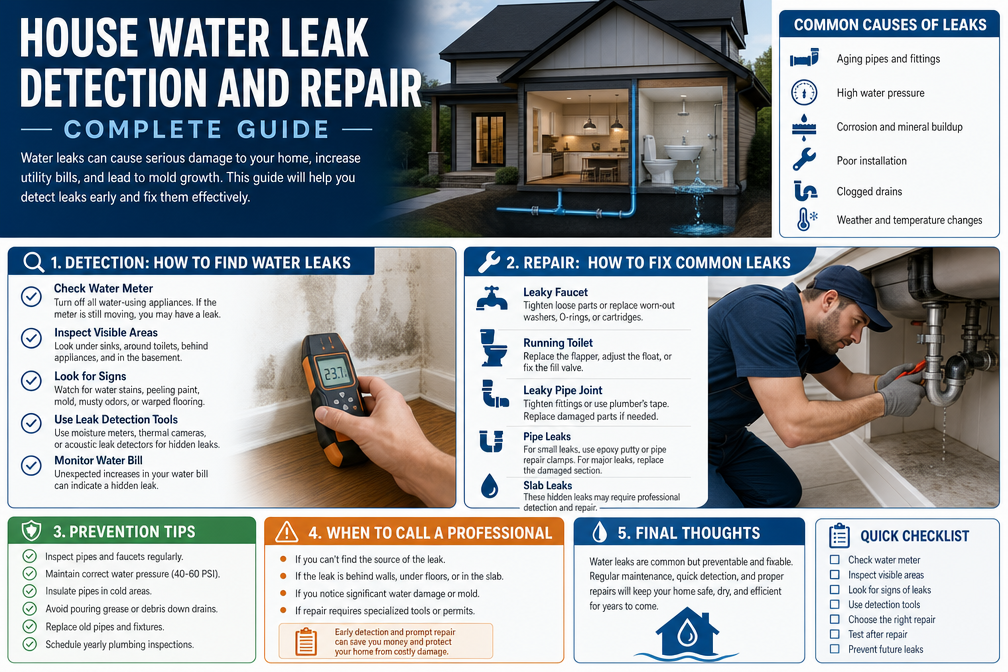
Water leaks demand your attention the moment they start. A single drip can waste thousands of gallons each year, raise your bills, and weaken your home’s structure. Mold grows fast, wood rots silently, and hidden leaks destroy walls and foundations before you notice. You need clear steps to detect, repair, and prevent leaks so your home stays safe, dry, and efficient.
Why is water leak repair urgent?
A leak starts damaging your home the moment water escapes. Mold can grow in 24–48 hours, and a single dripping faucet wastes 3,000+ gallons per year. Ignoring leaks leads to structural rot, inflated bills, and foundation damage.
How do you detect a hidden leak at home?
- Water meter test: Shut off all water, check the leak indicator, and recheck after 2 hours. Any change confirms a leak.
- Toilet dye test: Add food coloring to the tank. If color appears in the bowl, the flapper valve is faulty.
- Fixture inspection: Run tissue around joints under sinks and heaters.
- Wall clues: Bubbling paint, musty odors, or hissing sounds indicate hidden leaks.
What tools do professionals use?
- Acoustic detectors amplify faint hissing inside walls.
- Thermal imaging cameras reveal hot or cold water pooling.
- Moisture meters confirm dampness levels.
- Tracer gas pinpoints micro‑leaks invisible to other methods.
What are the immediate steps when you find a leak?
- Stop the flow: Shut off the nearest valve or main supply.
- Ensure safety: Cut power if water is near outlets.
- Document damage: Take photos for insurance.
- Remove standing water: Use towels or a wet/dry vacuum.
- Apply a temporary fix: Tape, epoxy putty, or clamps.
- Dry thoroughly: Use fans and dehumidifiers.
Which DIY fixes work best?
| Method | Best For | Pros | Cons |
| Silicone Tape | Small cracks | Works on wet pipes | Temporary only |
| Epoxy Putty | Pinhole leaks | Strong seal | Needs dry surface |
| Repair Clamp | Straight bursts | Fast and reliable | Not for joints |
| Slip Coupling | PVC breaks | Near‑permanent | Requires cutting |
What do permanent repairs involve?
- Pipe replacement: Cut out damaged sections and install new copper, PEX, or PVC.
- Trenchless main line repair: Pull new pipe through old one, saving landscaping.
- Re‑piping: Replace aging galvanized steel or corroded copper.
How much does leak repair cost in 2026?
- Main line repair: $354–$1,696 (avg. $1,025).
- Hidden pipe leak: $500–$1,500.
- Fixture repair: $150–$300.
Does insurance cover water leaks?
Insurance usually covers sudden, accidental damage (burst pipes). It rarely covers gradual corrosion. Most policies pay for resultant damage (drywall, flooring) but not the plumbing repair itself.
How can you prevent future leaks?
- Monitor water pressure: Keep below 80 psi.
- Insulate pipes: Protect against freezing.
- Install smart leak detectors: Alerts your phone instantly.
- Annual inspection checklist: Test toilets, check hoses, inspect water heater, and verify meter stability.
FAQ
- Can you fix a leak yourself? Yes, if it’s visible and non‑pressurized. Call a plumber for hidden or structural leaks.
- How long do temporary fixes last? Usually a few days to a week.
- What is the most common household leak? Toilets — often silent, wasting hundreds of gallons daily.
XKolab is a knowledge-driven platform that publishes practical, well-researched content on technology, business, digital services, finance, and online tools. It helps readers make informed decisions through clear guides, expert insights, and up-to-date information tailored to modern digital needs.