
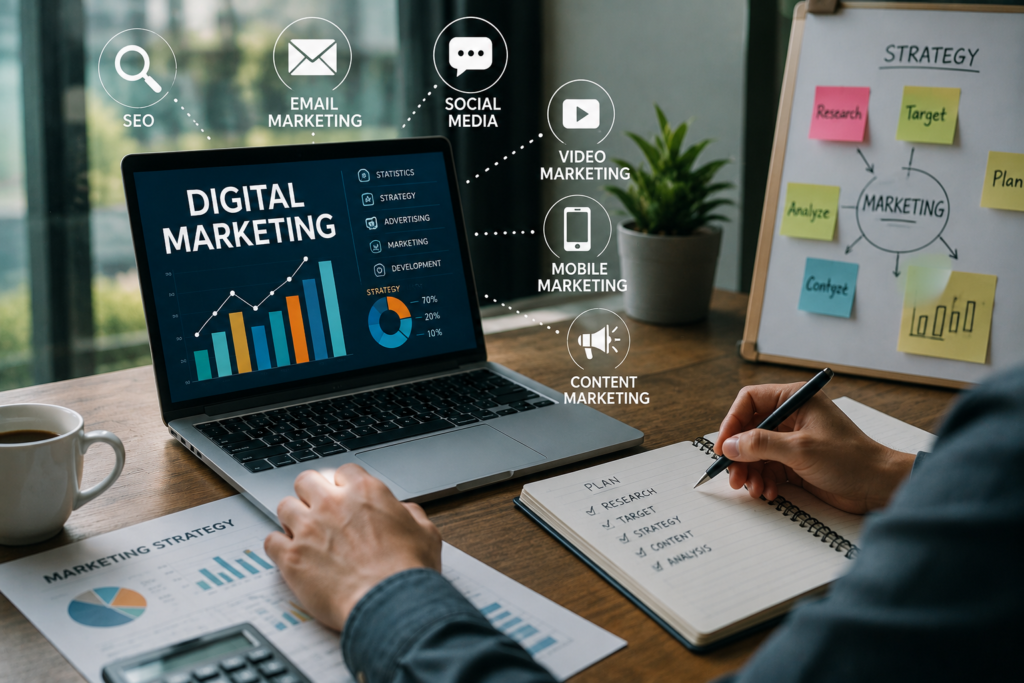
Digital marketing promotes brands, products, and services through the internet and other digital channels. You reach buyers on Google, Instagram, YouTube, email, and mobile apps. You also see which campaign earns each dollar. Where do you want to start: business growth, a new career, or extra income?
Statista reports that digital channels account for about 70 percent of total global ad investment. Trackers project the digital share at 68.7 percent in 2026, so nearly seven of every ten ad dollars go online. Demand for skilled marketers follows that money. Your next step starts with the basics. statistafungies
What Is Digital Marketing?
Digital marketing covers every promotional effort that runs through an online channel. Websites, search engines, social platforms, email, video, and mobile apps all count. Traditional marketing uses print, TV, and radio. Digital marketing adds precise targeting, real-time interaction, and exact measurement.
Do you see the difference? A billboard reaches every person who passes it. A digital ad reaches the 28-year-old in your city who searched for sneakers today.
| Feature | Traditional marketing | Digital marketing |
| Audience | Broad and general | Precise and segmented |
| Feedback | Delayed | Real time |
| Measurement | Rough estimates | Exact metrics |
| Budget | High entry cost | Flexible and scalable |
| Changes | After the campaign ends | Any time |
Why Does Digital Marketing Matter for Your Business?
Three advantages explain the shift:
- Precise targeting: Marketers select audiences by age, location, interests, and buying behavior.
- Measurable ROI: Google Analytics shows user paths, conversions, and revenue for each campaign.
- Cost efficiency: Small businesses launch on a few hundred dollars per month and adjust spend as results arrive.
Measurement habits keep improving. Litmus reports that only 21 percent of marketing leaders skip ROI measurement now, down from 36 percent in 2023. Do you track your own return yet? busyseed
Channel returns differ widely. One 2026 roundup shows that email returns $36 to $42 per dollar, Google Ads returns about $2, and paid social returns about $1.75. Smart marketers shift budget toward the channels that pay back the most. marketful
Market power sits with a few platforms. One industry analysis shows that Google, Meta, and Amazon hold 62.3 percent of global digital ad spend in 2026. Estimates differ by tracker, so treat every market figure as a range. fungies
What Are the 7 Types of Digital Marketing?
Seven channels form the foundation. Each one serves a different goal.
What Is Search Engine Optimization (SEO)?
SEO improves your website’s content, structure, and authority. Google then shows your pages higher in free results. Three areas matter. On-page SEO covers keywords, headings, and content quality. Technical SEO covers site speed, mobile layout, and crawlability. Off-page SEO covers backlinks and brand mentions. Local SEO helps nearby customers find you.
Does SEO still pay off in the AI era? Yes. BrightEdge data shows that AI search drove under 1 percent of referral traffic from January to August 2025, and organic search stayed the main source of conversions. busyseed
What Is Pay-Per-Click (PPC) and SEM?
Advertisers bid on keywords. Ads appear at the top of Google results or inside social feeds. You pay when someone clicks. Search Engine Marketing (SEM) combines paid and organic search tactics.
WordStream reports average conversion rates of 4.4 percent on the search network and 0.57 percent on the display network. Search ads capture buyers who already want a product. Display ads build awareness. The
What Is Social Media Marketing?
Social media marketing grows a community and runs targeted ads on Facebook, Instagram, LinkedIn, TikTok, YouTube, and X. Each platform fits a goal. LinkedIn suits B2B lead generation. Instagram and TikTok suit visual brands and short video.
Platform power shifts fast. One eMarketer forecast shows that Meta will overtake Google as the largest digital ad seller, with 26.8 percent of global ad spend against 26.4 percent. fungies
What Is Content Marketing?
Content marketing distributes useful media to attract and keep an audience. Blog posts, videos, podcasts, infographics, case studies, and guides all qualify. Content feeds every other channel. SEO needs articles, social needs posts, and email needs newsletters.
Google rewards experience, expertise, authoritativeness, and trustworthiness (E-E-A-T). Which questions do your customers ask every week? Answer those first.
What Is Email Marketing?
Email marketing nurtures leads and drives sales through personalized, segmented campaigns. You own the list, and you control the reach.
The returns stand out. Litmus reports an average return of $36 per dollar spent, and 30 percent of marketing leaders earn $36 to $50. EmailToolTester data shows that five to eight emails per month produce the top return, near $48 per dollar. Mailchimp, HubSpot, Klaviyo, and Brevo handle the setup. Segment your list by behavior. Automate welcome series, abandoned cart reminders, and re-engagement flows. busyseedemailtooltester
What Is Affiliate Marketing?
Affiliates promote your products and earn a commission on each sale or lead. You pay for results. Networks such as Amazon Associates, ShareASale, Impact, and CJ Affiliate connect brands with publishers.
What Is Influencer Marketing?
Creators promote your product to their audience for a fee or commission. Pick creators whose followers match your buyer. Smaller creators often build tighter communities, so test several audience sizes.
Other channels extend the seven: mobile marketing, SMS, video, marketing automation, retail media, and connected TV.
How Do Digital Marketing Channels Work Together?
Channels cover different stages of the buyer journey. Map each one to a stage.
| Stage | Goal | Best channels |
| Awareness | Reach new people | SEO, social media, video, influencers |
| Consideration | Build trust | Content, email, retargeting ads |
| Conversion | Close the sale | PPC, landing pages, email offers |
| Retention | Earn repeat sales | Email, loyalty programs, community |
A shopper finds your blog post on Google, follows you on Instagram, joins your email list, and buys after a discount offer. Every channel plays a part.
What Does a Digital Marketer Do?
A digital marketer plans, runs, and measures online campaigns. Daily tasks include keyword research, audience research, ad copy, content briefs, and campaign setup in Google Ads and Meta Ads Manager. Marketers also schedule posts, run A/B tests, and report results from Google Analytics 4. Which of those tasks fits your strengths?
Which Digital Marketing Skills and Tools Should You Learn?
Start with data analysis, copywriting, SEO basics, paid media, and email automation. Add creativity and project management. AI tool literacy carries real weight now.
| Task | Popular tools |
| SEO | Google Search Console, Semrush, Ahrefs |
| Analytics | Google Analytics 4, Looker Studio |
| Paid ads | Google Ads, Meta Ads Manager |
| Mailchimp, HubSpot, Klaviyo | |
| Social | Hootsuite, Buffer |
| Design | Canva |
How Do Beginners Start Digital Marketing?
Follow the steps below:
- Learn the fundamentals. Study the seven channels and the buyer journey.
- Pick one channel first. Master SEO, paid ads, or email before you branch out.
- Take a structured course. Choose one with hands-on projects.
- Practice on a real project. Launch a blog, a YouTube channel, or a page for a local shop.
- Track results. Set up Google Analytics 4 and record every outcome.
- Build a portfolio. Show numbers, such as traffic growth or lower cost per lead.
- Earn certifications. Google Skillshop and HubSpot Academy offer recognized options.
- Apply for internships and freelance gigs. Real clients accelerate your growth.
How Do You Choose the Right Digital Marketing Course?
Check five points before you enroll:
- The curriculum covers all seven channels.
- Projects use real tools such as Google Ads and GA4.
- The certificate carries industry recognition (Google, HubSpot Academy, Meta Blueprint, Coursera, Semrush Academy).
- Lessons reflect AI search and automation updates.
- Instructors have real campaign experience.
Free options exist on Google Skillshop, HubSpot Academy, and YouTube. Paid programs on Coursera add structure and graded projects. Which format matches your schedule?
What Digital Marketing Jobs Can You Get?
The field offers many entry points:
- SEO specialist
- PPC or paid media specialist
- Social media manager
- Content marketer
- Email marketing specialist
- Marketing analyst
- Growth marketer
- Digital marketing manager
- Freelance consultant
Search “digital marketing jobs” on LinkedIn and Indeed to see which skills employers request most in your area.
How Much Does a Digital Marketer Earn?
Salary depends on country, role, experience, industry, and proven results. Local job boards give the most accurate numbers. Compare job posts in your city and for remote roles on LinkedIn, Indeed, and Glassdoor.
You raise your pay in three ways. Specialize in a high-demand channel. Show measurable results in your portfolio. Learn analytics, because marketers who connect spend to revenue earn trust fast.
How Do You Make Money With Digital Marketing?
Seven paths work:
- Freelance services: Sell SEO, ad management, or content to small businesses.
- Agency job: Learn across many clients and industries.
- In-house job: Own one brand’s growth.
- Affiliate marketing: Earn commissions through reviews and comparison content.
- Blog or YouTube channel: Earn from ads, sponsors, and affiliate links.
- Digital products: Sell templates, courses, or ebooks.
- Your own agency: Scale once you hold steady clients.
What Are Examples of Digital Marketing?
Real campaigns blend channels. Five scenarios show how:
- Local bakery: Claims a Google Business Profile, posts Instagram Reels, and collects customer reviews.
- Software company: Publishes SEO blog posts, offers a free guide for email signups, and runs a nurture sequence.
- Online store: Runs Meta retargeting ads to cart abandoners and sends discount emails.
- Creator: Shares affiliate links in YouTube descriptions and newsletters.
- Nonprofit: Tells donor stories through video and email appeals.
Which scenario looks closest to your situation?
How Do You Choose a Digital Marketing Company or Agency?
A digital marketing agency runs campaigns for you. An in-house team works only on your brand. Agencies bring broad expertise. In-house teams bring deep brand knowledge.
Judge agencies on six points:
- Case studies with real numbers
- Expertise in your channels
- Clear monthly reports
- Plain contract terms
- Regular communication
- Fit with your budget
Ask direct questions. Which KPIs will you report? Who manages my account? How do you handle ad budgets? A promise of guaranteed first-page results signals a warning.
How Do You Find Digital Marketing Services Near You?
Search “digital marketing agency near me” and open the Google Maps results. Read reviews, check portfolios, and call two or three shortlisted firms.
Business owners attract local clients with five steps:
- Claim and complete your Google Business Profile.
- Keep your name, address, and phone number consistent everywhere.
- Ask happy customers for reviews.
- Create location pages for each service area.
- Use local keywords in titles and headings.
How Do You Build a Digital Marketing Strategy?
Work through eight steps:
- Set SMART goals. Make each goal specific, measurable, achievable, relevant, and timed.
- Define audience personas. Write down age, location, problems, and buying triggers.
- Audit competitors. Study their keywords, ads, and content.
- Choose channels. Match each channel to a buyer stage.
- Set a budget. Start small and scale winners.
- Plan a content calendar. Schedule posts, emails, and campaigns.
- Track KPIs. Review results weekly.
- Test and refine. Keep what works and cut what fails.
| KPI | Definition |
| CTR | Clicks divided by impressions |
| CPC | Cost per click |
| CPA | Cost per acquisition |
| ROAS | Revenue divided by ad spend |
| CAC | Total cost to win one customer |
| Conversion rate | Share of visitors who take action |
Which Digital Marketing Trends Matter in 2026?
Six trends shape strategy:
- AI search and automation: Marketers write briefs, segment audiences, and test creative faster with AI tools.
- Short video: Reels, Shorts, and TikTok dominate attention.
- Retail media: One industry roundup values retail media at $150 billion worldwide, above traditional TV ad spend. affninja
- First-party data: Email lists and customer data replace third-party cookies.
- Personalization: Dynamic content lifts engagement across email and web.
- Mobile-first design: Most visitors arrive on a phone, so test every page there.
Which Digital Marketing Mistakes Cost You the Most?
Choose the positive alternative to each costly habit:
- Marketers who try every channel at once spread the budget thin. Master one channel first.
- Teams that launch campaigns before they set goals lose focus. Set clear goals first.
- Brands that ignore email leave high returns on the table. Build your list from day one.
- Many websites load slowly on phones. Test speed and mobile layout often.
- Reports that list clicks hide real results. Track revenue and cost per customer.
Frequently Asked Questions (FAQs)
1. What is digital marketing?
Digital marketing is the promotion of products, services, or brands through digital channels such as search engines, websites, social media, email, and online advertisements.
2. What are the main types of digital marketing?
The main types include search engine optimization (SEO), social media marketing, content marketing, email marketing, pay-per-click (PPC) advertising, video marketing, affiliate marketing, and influencer marketing.
3. Why is digital marketing important for businesses?
Digital marketing helps businesses reach relevant audiences, build brand awareness, generate leads, increase website traffic, and measure campaign performance.
4. How does SEO help digital marketing?
SEO improves a website’s visibility in organic search results by optimizing its content, structure, and technical performance. It can help attract relevant visitors without paying for every click.
5. Is digital marketing suitable for small businesses?
Yes. Small businesses can start with cost-effective methods such as local SEO, useful blog content, email marketing, and organic social media posts. Paid advertising can be added when the budget allows.
6. What skills are needed for digital marketing?
Useful skills include SEO, content writing, social media management, keyword research, online advertising, analytics, communication, and campaign planning.
7. How can businesses measure digital marketing success?
Businesses can track website traffic, engagement, click-through rates, conversion rates, leads, sales, customer acquisition costs, and return on investment (ROI).
8. What is the difference between digital marketing and traditional marketing?
Digital marketing uses online and digital channels, while traditional marketing typically relies on methods such as print advertisements, billboards, and television or radio commercials. Digital campaigns often provide more detailed performance data and flexible targeting.
Conclusion
Digital marketing is an important tool for businesses looking to grow their online presence, connect with potential customers, and increase sales. By combining SEO, content marketing, social media, email campaigns, and paid advertising, businesses can develop a strategy that supports their specific goals and budget.
The key to successful digital marketing is understanding the target audience, publishing valuable content, choosing the right channels, and regularly measuring results. As digital platforms and customer behavior continue to evolve, businesses that adapt their strategies and focus on delivering value will be better positioned to build trust, strengthen their brand, and achieve sustainable growth.
Xkolab is a website associated with digital marketing and SEO-related topics, including AI search optimization, content strategy, topical authority, and online visibility.