
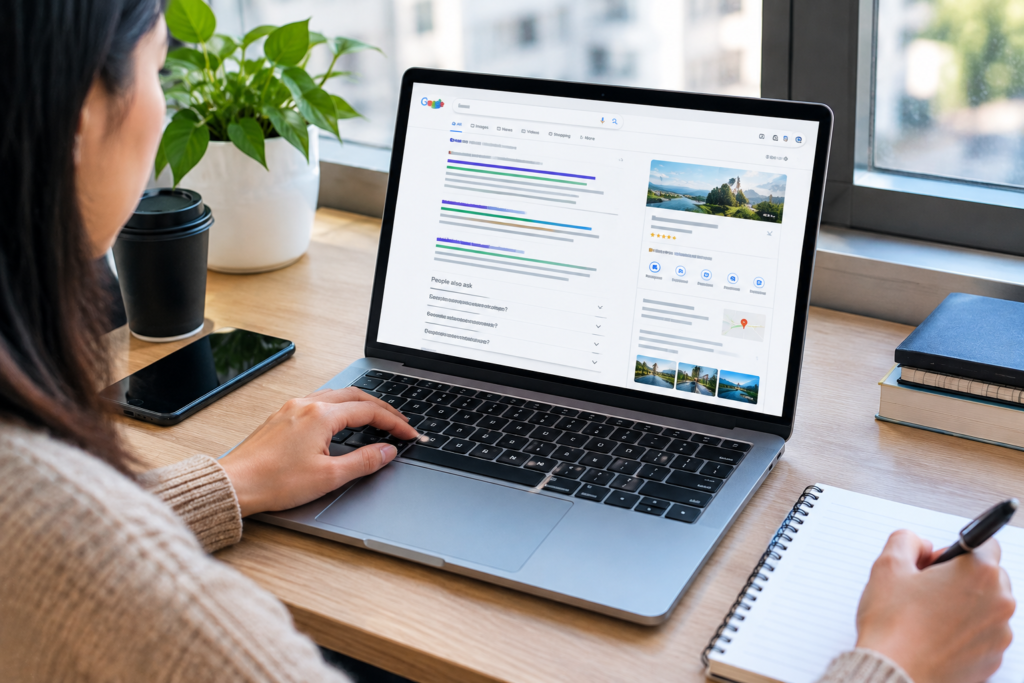
A SERP is the page a search engine displays after you enter a query. Google, Bing, Yahoo, and DuckDuckGo each build one for every search. Have you ever wondered why one site wins the top spot while another sits on page five? The SERP holds the answer.
SERP stands for Search Engine Results Page. Google handles roughly 8.5 billion searches per day, and each search produces one SERP. Every marketer, writer, and site owner competes on that page. Read on to learn the definition, the features, the click data, and the tactics that win in 2026. searchlab
Quick answer:
- Definition: A SERP is the results page a search engine returns for a query.
- Parts: Paid ads, organic results, and SERP features fill the page.
- Trend: AI Overviews and zero-click searches now reshape clicks.
- Goal: Aim for visibility, citations, and clicks.
What Does SERP Stand For?
SERP stands for Search Engine Results Page. The term names the page that loads after you submit a keyword or question. Each search engine assembles its own version from a live index of web pages.
Every SERP is dynamic. Location, device, language, and search history change the output. Marketers call that SERP variability. Why does it matter to you? Your position in New York may differ from your position in London.
What Is SERP in SEO and Digital Marketing?
In SEO, the SERP is the arena. You optimize pages so that they appear high on it. A SERP position is the slot your page holds for one keyword. Your position moves as competitors publish, links change, and Google updates its systems.
| Term | Definition | Role |
| SERP | The page a search engine displays after a query | The place where users see your result |
| SERP position | The slot your page holds for one keyword | The score you track |
| SEO | Search Engine Optimization, the work that improves organic visibility | The method that earns your spot |
| SEM | Search Engine Marketing, mainly paid Google Ads campaigns | The method that buys your spot |
In digital marketing, teams use the SERP to plan content, measure visibility, and judge competitors. Paid teams bid on the top slots. SEO teams earn free slots. Which route fits your budget?
How Did the SERP Evolve Over Time?
Early SERPs showed ten blue links and a few ads. Google added Universal Search in 2007 and blended images, news, and video into one page. The Knowledge Graph arrived in 2012 and introduced entity panels. Featured snippets launched in 2014 and created “position zero.” shno
Mobile-first indexing later shifted the focus to phone results. Google launched AI Overviews in the US in 2024 and expanded AI Mode in 2025. Today the SERP answers questions directly. Do you see why a click is only one goal among several?
What Are the Main Parts of a SERP?
Every SERP holds three core parts.
- Paid ads. Advertisers bid for slots through Google Ads. Google labels each one “Sponsored.” Organic position one still wins the contest, because First Page Sage data shows it earns about 19 times the clicks of the top paid ad. traficxo
- Organic results. Algorithms order earned pages by relevance, quality, and authority. Each result shows a title link, a URL, and a meta description.
- SERP features. Extra modules answer the query or show media. Google adds new ones each year.
Which SERP Features Appear Most Often in 2026?
Modern SERPs hold far more than links. Google displays 37 distinct SERP features in the US, and features fill 60 to 80 percent of the above-the-fold space on most commercial queries. Organic blue links now share the screen with many modules. growbydata
Some features appear on almost every page. A color study of 4,000 SERPs found People Also Ask on 92 percent of results and an AI Overview on 70 percent. The sample leans toward conversational and commercial queries, so treat the shares as an upper range. cloro
Featured snippets show a split story. They absorb about 42.9 percent of clicks when present, yet Ahrefs found their visibility fell 64 percent in the first half of 2025, from 15.41 to 5.53 percent of US desktop queries. Which feature could you win first? shno
- AI Overviews. Google generates a summary at the top. Earn a citation with clear, sourced answers.
- AI Mode. Google runs a conversational view for follow-up questions. Cover related sub-questions in depth.
- Featured snippets. Google pulls one answer from one page. Give a direct answer in 40 to 60 words.
- People Also Ask (PAA). Google shows expandable related questions. Answer each question in two sentences.
- Local pack. Google shows three map results with reviews. Complete your Google Business Profile.
- Knowledge panel. Google summarizes a brand, person, or place. Keep facts consistent across your site, Wikipedia, and Wikidata.
- Image and video packs. Google shows visual rows for visual intent. Add descriptive file names and alt text.
- Top stories. Google shows news carousels. Publish fresh, sourced reports.
- Product carousels. Google shows product cards with price and seller. Submit a Merchant Center feed.
- Sitelinks. Google adds extra links under a brand result. Keep a clear site structure.
- Discussions and forums. Google surfaces threads from Reddit and Quora. Join relevant threads with real expertise.
- Related searches. Google suggests queries at the page bottom. Mine them for subtopics.
How Do AI Overviews and AI Mode Change SERP Clicks?
AI Overviews reshape the top of the page. They appear on more than 20 percent of Google searches and cut click-through rates by nearly 60 percent when they show. Sundar Pichai said at Google I/O 2026 that they reach over 2.5 billion monthly users. techwysetechwyse
Studies differ on the exact size of the drop, yet all point the same way. AWR measured a 52 percent fall at position one on the US desktop, from 20.02 to 9.69 percent in July 2026. Ahrefs’ study of 300,000 keywords found a 58 percent cut. Sistrix data from Germany shows position one dropping from 27 to 11 percent. Google Organic CTR by Position: 2026 Study + AI Overviews – AWR SEO Guide +2
A randomized experiment confirms the pattern. Agarwal and Sen found that organic clicks fell 38 percent, and zero-click searches jumped from 54 to 72 percent, when participants saw an AI Overview. techwyse
AI Mode adds more pressure. It drove just 0.34 percent of searches in SparkToro’s study window, but it has passed one billion monthly users. One tracker reports a 93 percent zero-click rate inside AI Mode. shopifreakssearchlogistics
Citations soften the blow. Seer Interactive found that cited brands earned 120 percent more clicks, although their rate stayed 38 percent below the rate on queries that show classic results only. Will you earn the citation or lose the click? advancedwebranking
What Is a Zero-Click Search?
A zero-click search finishes on the SERP. The user reads the answer, then leaves or types a new query. SparkToro’s Similar web-based study found that 68.01 percent of US Google searches ended with zero clicks in the first four months of 2026, up from 60.45 percent in 2024. searchengineland
Mobile drives the trend. Zero-click reaches about 77 percent on mobile and roughly 50 percent on desktop. Only 231 of every 1,000 US searches now reach the open web, down from 360 in 2024. relevantaudiencesearchlogistics
Sources measure zero-click in different ways. An iPullRank panel of 10.2 billion searches found 46.96 percent between October 2024 and December 2025. Treat each figure as a marker, and check your own Google Search Console data. Which of your keywords lose the most clicks? ipullrank
Impressions still matter. A brand seen on the SERP earns later searches and direct visits.
How Much Traffic Does Each SERP Position Earn?
Position drives clicks. Sistrix analyzed more than 80 million keywords and found 28.5 percent CTR at position one, 15.7 percent at position two, 11 percent at position three, and 2.5 percent at position ten. Backlinko’s analysis of 4 million results put position one at 27.6 percent. Across studies, position one earns between 19 and 39.8 percent of clicks. Google CTR Data: How AI Overviews Cut Organic Clicks +2
Picture a keyword with 50,000 monthly searches. At a 27.6 percent CTR, position one earns about 13,800 visits. Which keyword could deliver that volume for you? outerboxdesign
Long-tail phrases help on smaller budgets. One 2026 compilation reports 3 to 5 times higher CTR for long-tail keywords than for short-tail ones. Target them early. The stack
How Does Google Decide Which Result Ranks First?
Google weighs many signals at once. Six groups matter most.
- Relevance. Pages must match the query and its intent. RankBrain and BERT interpret language and context.
- Content quality. Google favors helpful, original pages that show experience, expertise, authoritativeness, and trust (E-E-A-T).
- Backlinks. Links from respected sites act as votes of confidence.
- Page experience. Core Web Vitals, HTTPS, and mobile-friendly design shape the visit.
- Freshness. Recent updates matter on news and fast topics.
- Context. Location, device, and language adjust the final order.
Google also enforces spam policies through SpamBrain. Scaled, low-value pages risk a drop in position.
What Are the Four Types of Search Intent on a SERP?
Intent explains why each SERP looks the way it does. Match your page to the dominant type.
- Informational. The user wants knowledge, such as “what is a SERP.” Guides and explainers win.
- Navigational. The user wants a specific site, such as “Semrush login.” Brand pages win.
- Commercial. The user compares options, such as “best SERP tracker.” Reviews and comparisons win.
- Transactional. The user wants to buy or sign up, such as “SERP API cost.” Product and pricing pages win.
Picture the query “running shoes.” Google shows product carousels and retail categories. The query “how to choose running shoes” shows guides. The SERP tells you which format Google trusts.
How Do You Run a SERP Analysis?
A SERP analysis shows you what to build before you write a word. Follow seven steps.
- Search your target keyword in an incognito window.
- Set the location and device to match your audience.
- Note the dominant intent and the content types on page one.
- List every SERP feature that appears.
- Review the top ten pages for word count, H2 titles, entities, links, and publish date.
- Spot gaps, such as unanswered questions, outdated statistics, and thin sections.
- Write a brief that fills every gap and adds original value.
Which gap will you fill first?
How Can You Win a Higher SERP Position?
Start with the basics, then add advanced tactics.
- Write title tags near 60 characters and place the keyword first.
- Write meta descriptions near 155 characters with a clear benefit and a call to action.
- Match search intent within the first 100 words.
- Use question-style H2 titles to capture PAA and snippet slots.
- Add schema markup for Article, Organization, Product, and Review data.
- Link related pages with descriptive anchor text.
- Earn backlinks through original research and digital PR.
- Compress images and improve page speed.
- Show author names, bios, and credentials to signal E-E-A-T.
- Update key pages every quarter.
Which tactic will you test first?
How Can You Win Featured Snippets and People Also Ask Boxes?
Snippets reward structure. Place a 40 to 60 word answer directly under a question title. Use an ordered list for steps. Use a table for comparisons. Add a short definition sentence near the top of the page.
PAA boxes reward brevity. Answer each related question in two sentences. Then add depth below. Google often lifts the first clean answer it finds.
How Do You Earn Citations in AI Overviews?
Citations now act like a second rank. Six moves raise your odds.
- Open each section with a direct answer.
- Name entities clearly, such as brands, tools, people, places, and standards.
- Publish original data, tables, and expert quotes.
- Add structured data and consistent author details.
- Refresh statistics on a fixed schedule.
- Allow Googlebot to crawl each page, and remove nosnippet tags.
Which SERP Tools Should You Use?
A SERP tool shows where you stand and who beats you. Pick tools by task.
| Tool type | Examples | Best use |
| First-party data | Google Search Console | Real impressions, clicks, CTR, and average position |
| Rank trackers | Semrush, Ahrefs Rank Tracker, Moz Pro, Sistrix | Daily position data and SERP feature history |
| SERP checkers | Semrush, Ahrefs, Moz | Results by keyword, location, and device |
| SERP APIs | SerpApi, DataForSEO, Serpstat | Structured JSON for custom dashboards |
A SERP API returns clean data from live results. A “SERP company” search often surfaces SerpApi and Serpstat, since both brands grew around the term. Choose licensed APIs over home-built scrapers to protect your data quality.
What Does SERP Mean in HR and Payroll?
SERP has a second definition outside search. In HR and finance, it stands for Supplemental Executive Retirement Plan. Companies offer it to senior leaders as extra retirement income above a standard 401(k).
A SERP is a nonqualified deferred compensation plan. Employers set the contribution terms and the payout schedule. Payroll teams record deferred amounts and apply tax rules at payout. Consult a tax professional for plan details.
What Does Serp Mean in Medicine?
The word also appears in life sciences. Serpins are a protein family known as serine protease inhibitors. They help regulate protease activity in the body.
Add a context word to any search. Terms such as “digital marketing,” “retirement plan,” or “protein” steer Google to the right meaning.
What Are Common SERP Mistakes?
Many teams repeat the same errors. Do you recognize any?
- Some teams track position one only. Features and citations also drive visibility.
- Some teams write before they check intent. A mismatched format loses to the page type Google already trusts.
- Some teams trust one CTR benchmark. Studies range from 19 to 39.8 percent at position one.
- Some teams skip mobile checks. Mobile zero-click sits near 77 percent.
- Some teams publish once and leave. Fresh pages keep their edge.
FAQ
1. What does SERP mean?
SERP stands for Search Engine Results Page. It is the page displayed by a search engine after a user enters a search query.
2. What appears on a SERP?
A SERP can include organic search results, paid advertisements, featured snippets, image results, videos, maps, local listings, People Also Ask sections, and other search features.
3. Why is SERP important for SEO?
SERPs help businesses understand how their websites appear in search results and where there are opportunities to improve visibility, rankings, and organic traffic.
4. What is SERP ranking?
SERP ranking refers to the position of a webpage within search results for a particular query. Higher-ranking organic pages generally have greater visibility.
5. How can I improve my SERP position?
Businesses can improve search visibility through relevant and helpful content, keyword research, technical SEO, strong internal linking, quality backlinks, good page experience, and optimization for search intent.
6. What is a SERP feature?
A SERP feature is a search-result element beyond traditional organic listings. Examples include featured snippets, knowledge panels, image packs, local packs, and People Also Ask.
Conclusion
SERPs are an important part of how users discover information, products, and businesses online. Understanding SERP layouts, rankings, and search features can help businesses develop more effective SEO strategies. By creating useful content, optimizing websites for search intent, and following sound technical and on-page SEO practices, businesses can improve their visibility and create more opportunities to attract relevant organic traffic.
Xkolab is a digital marketing agency focused on helping brands strengthen their online presence through guest posting, high-quality link building, strategic link insertion, technical SEO audits, on-page optimization, and performance analytics. Its services combine creative marketing with data-driven strategies to improve search visibility, organic traffic, and digital growth.