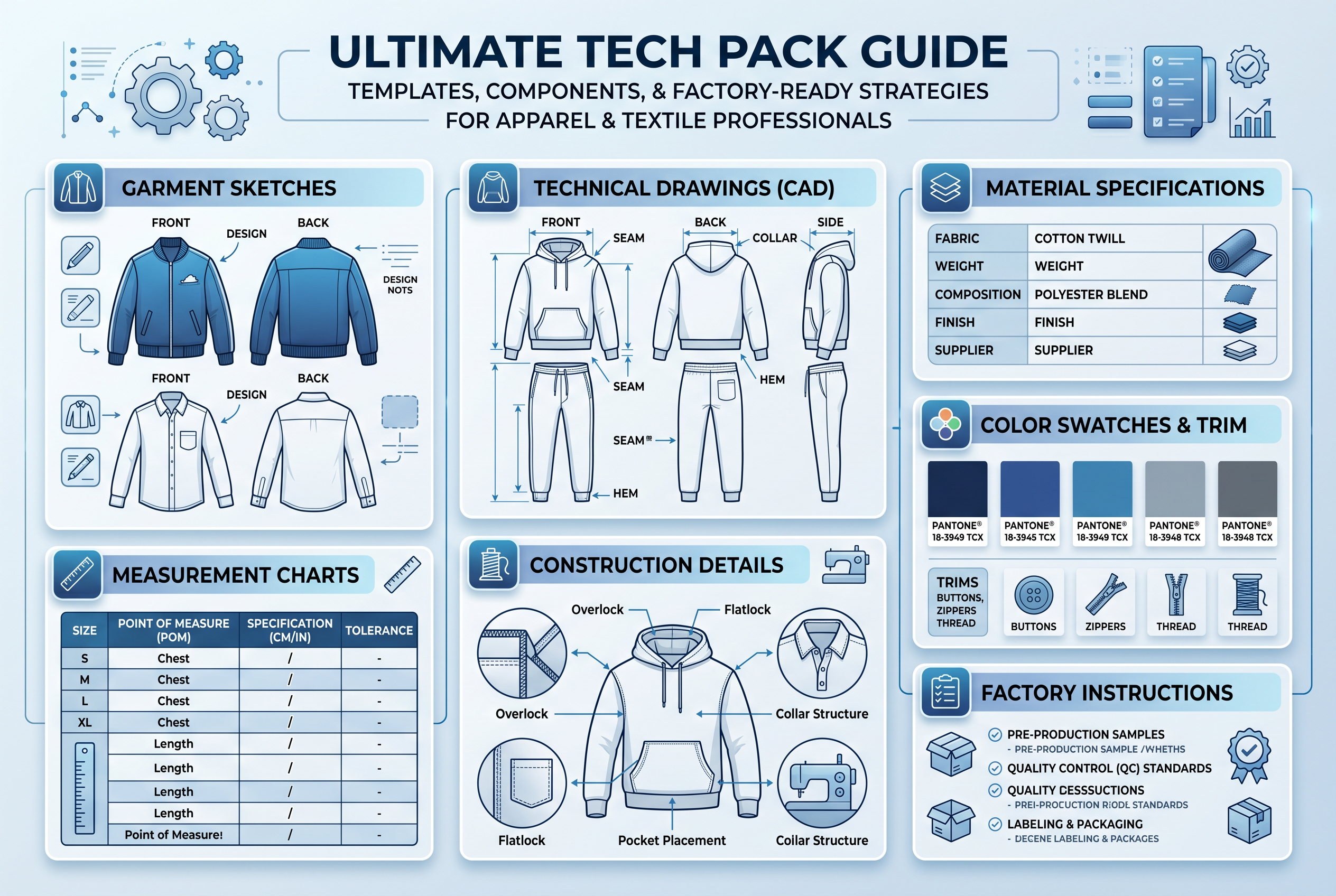
You want your garment produced exactly as you imagine it. A Tech Pack gives factories the blueprint they need to deliver accuracy. It explains every detail: sketches, fabrics, trims, measurements, and costs. You avoid errors, save money, and speed up production. In 2025, fashion brands using structured Tech Packs reported 30% fewer sample rounds before final approval. You gain control, your factory gains clarity, and your product reaches the market faster. Global apparel reports confirm that brands with advanced Tech Pack systems achieved 20% higher quality consistency across collections.
What makes a Tech Pack essential?
A Tech Pack is the blueprint of your garment. It communicates every detail to manufacturers, ensuring accuracy in production. Without it, factories rarely accept orders. You save time, reduce costs, and improve fit quality when you use a complete Tech Pack.
How does a Tech Pack save you money?
Factories quote prices based on detail. A clear Tech Pack helps them estimate labor and material costs correctly. You avoid hidden expenses and delays. In 2025, fashion startups reported 30% fewer sample rounds when using structured Tech Packs.
What should you include in a Tech Pack?
- Cover Page: Brand name, style number, season, vendor, country of origin, deadlines, and revisions.
- Technical Sketches: Black-and-white flats showing front, back, side, and inside views. Include seam lines, stitches, and construction details.
- Bill of Materials (BOM): Fabrics, linings, threads, trims, closures, labels, and packaging.
- Measurement Spec Sheet: Points of measurement for each size. Include chest, waist, hips, collar, cuffs, and pockets.
- Graded Spec Template: Size gradings with formulas to avoid math errors.
- Colorways & Artwork: Pantone references and placement for prints or embroidery.
- Construction Details: Stitch types, seam finishes, and fastening methods.
- Cost Sheet: Material, labor, and processing costs with quantities listed.
- Proto Comments & Fit Sheet: Notes on sample evaluation, fit adjustments, and factory feedback.
Which tools and formats should you use?
- Excel/Google Sheets: Best for BOM tables and graded specs.
- Adobe Illustrator: Ideal for technical sketches and detailed callouts.
- Canva: Useful for quick, visual-heavy layouts.
- Cloud-based platforms (e.g., Techpacker): Enable real-time collaboration, card libraries, and instant factory-ready PDFs.
Where can you find templates?
- Design-focused templates: Editable options on Kittl for graphic-heavy designs.
- Specific garment downloads: Free blueprints for hoodies, tank tops, and streetwear silhouettes from Glass Factory.
- Comprehensive kits: Factory-ready files with BOM and measurement specs from Bomme Studio and Tech Pack Templates.
- Free spreadsheets: Tabbed Excel/Google Sheets templates with linked cells and built-in formulas.
- Illustrator/Canva/PDF formats: For visual-heavy or print-ready layouts.
How do you outperform competitors?
Competitor templates provide shortcuts. You gain an edge by combining them with advanced structuring, cloud collaboration, and precise detailing. Use statistics, deadlines, and revision tracking to strengthen your Tech Pack. Add proto comments and fit sheets to ensure accuracy.
FAQs
What is a Tech Pack?
A Tech Pack is the blueprint of your garment. It explains sketches, fabrics, trims, measurements, and costs. Factories use it to produce accurate samples. In 2025, over 70% of apparel startups reported faster approvals when using structured Tech Packs.
Why do you need a Tech Pack?
You save money and reduce errors when you provide clear specifications. Factories quote prices correctly, and you avoid delays. Brands using Tech Packs achieved 20% higher consistency in fit and quality across collections.
What are the key components of a Tech Pack?
You include a cover page, technical sketches, BOM, measurement specs, graded spec, colorways, construction details, cost sheet, and proto comments. Each section ensures accuracy. Competitor templates often miss proto comments, yet they are vital for fit evaluation.
Can beginner designers create Tech Packs?
Yes. You can use free templates in Excel, Google Sheets, Illustrator, or Canva. Cloud-based platforms like Techpacker simplify the process. In 2025, small brands using Techpacker reported 40% faster product launches compared to spreadsheet-only workflows.
What happens if you skip a Tech Pack?
Factories reject incomplete orders. You risk costly mistakes and poor fit. Without a Tech Pack, designers often face three to five extra sample rounds, which increases expenses and delays.
Do small fashion brands need Tech Packs?
Yes. Even limited collections benefit from structured Tech Packs. They ensure accuracy, reduce costs, and build trust with factories. Small brands that adopted Tech Packs reported 25% lower production errors in 2025.
How do you start building a Tech Pack?
You begin with sketches and a cover page. Add BOM, measurement specs, and cost sheets. Use templates from Bomme Studio, Glass Factory, or Kittl for faster setup. Cloud platforms allow you to reuse specs for future collections.
Final Thoughts
A Tech Pack is more than a document. It is the foundation of professional garment production. You ensure accuracy, save costs, and speed up development when you use a detailed Tech Pack. In 2026, brands that adopted cloud-based Tech Pack systems reported 40% faster product launches compared to spreadsheet-only workflows.
Discover powerful tools and creative solutions at Xkolab.