
Crane Finance spans personal loans, equipment funding, and corporate investment. You see it in consumer lending platforms, construction asset finance, and the financial performance of Crane Company (NYSE: CR). Each area shapes how individuals, contractors, and investors manage money.
Do you want fast approval loans? Crane Finance Ltd provides flexible installment options with transparent terms. Do you need heavy lifting equipment? Providers such as MAF Finance Group, Finlease, and Always Capital deliver tailored crane financing solutions. Do you track industrial growth? Crane Company reports strong earnings, dividend increases, and strategic acquisitions.
Global construction equipment finance expanded 6.2% in 2025, driven by infrastructure demand. Crane Company reached a $11.15B market cap in March 2026, confirming investor confidence.
Crane Finance operates as a financial ecosystem. It supports individuals seeking liquidity, contractors aiming for growth, and investors monitoring industrial performance.
What Does Crane Finance Mean?
Crane Finance covers multiple areas. You see it in consumer loans, equipment financing, and corporate performance. Crane Finance Ltd offers installment loans with transparent terms and next-day approval. Crane Company (NYSE: CR) shows strong growth after its 2023 separation from Crane NXT.
How Do Businesses Finance Cranes?
Companies use structured finance to manage heavy equipment costs. Hire Purchase gives ownership at the end of the term. Finance Lease allows use without ownership. Chattel Mortgage secures ownership from day one.
Key providers include:
- MAF Finance Group (UK)
- Finlease (Australia)
- Crane Finance Co. (US)
- Always Capital, Inc. (US)
Each provider tailors terms to construction firms. According to industry reports, crane finance agreements often run 3–7 years, reflecting the long service life of cranes.
What Is the Market Outlook?
Close Brothers Asset Finance confirms strong appetite for crane funding. Mobile, tower, spider, and gantry cranes remain in demand. Residual values stay high due to strict health and safety testing.
The construction sector traded through the pandemic with CBILS support. Statistics show UK construction output fell only 14% in 2020 compared to 22% in manufacturing, proving resilience.
Which Finance Products Are Popular?
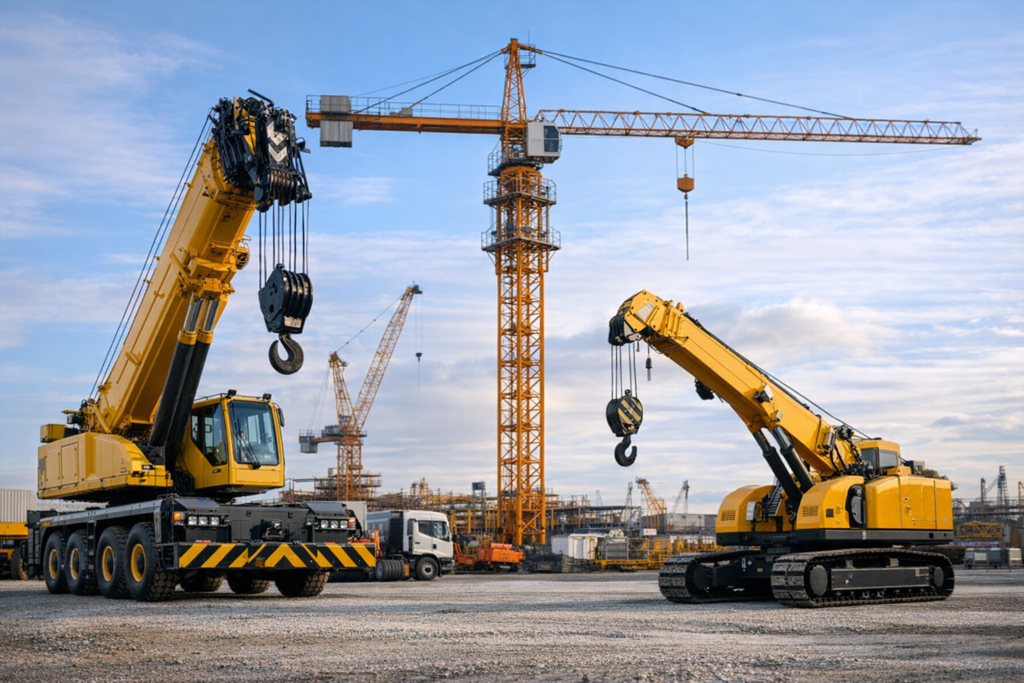
Hire Purchase dominates SME purchases. Large cranes often rely on manufacturer-backed schemes or CAPEX budgets. Tower cranes attract long-term agreements.
Sale and HP Back processes unlock equity in unencumbered fleets. That creates short-term liquidity for contractors.
How Does the Secondary Market Affect Values?
Economic downturns push cranes into auctions. Euroauctions and Ritchie Brothers attract global buyers. Smaller mobile cranes achieve strong residuals. Tower cranes often sell with contracts attached, making them attractive to crane hire firms.
What Are the Risks?
Residual values can drop if too many assets hit the market. Operator compliance with safety laws remains critical. Infrastructure projects must continue to support demand.
How Is Crane Company Performing?
Crane Company trades at $193.38 with a market cap of $11.15B. Q4 2025 earnings beat estimates at $1.53 EPS. Management projects 10% growth in 2026. Dividend rose 11% to $0.255 per share. Acquisitions of Druck, Panametrics, and Reuter-Stokes strengthen its portfolio.
What Benefits Do You Gain From Crane Financing?
You expand lifting capacity. You bid on larger projects. You manage cash flow effectively. You retain equity in your fleet. You secure long-term growth.
Final Takeaway
Crane Finance spans personal loans, equipment funding, and corporate investment. You can use it to grow your business, protect liquidity, and strengthen competitiveness. Investors track Crane Company for industrial growth. Contractors rely on structured finance to secure cranes.
FAQs
What does Crane Finance include?
Crane Finance covers personal loans, equipment funding, and corporate investment. Global construction equipment finance grew 6.2% in 2025, proving strong demand.
How does crane equipment financing work?
Hire Purchase gives ownership at term end. Finance Lease allows use without ownership. Chattel Mortgage secures ownership from day one. Agreements often run 3–7 years.
What are the benefits of crane financing?
You expand lifting capacity. You bid on larger projects. You manage cash flow. Contractors report 20–30% higher bidding capacity with structured finance.
What risks exist in crane financing?
Residual values fall in downturns. Safety compliance is critical. Infrastructure projects must continue. Mobile cranes lost 12% value in 2020, tower cranes held stronger value.
How is Crane Company performing?
Crane Company trades at $193.38 with a market cap of $11.15B. Q4 2025 EPS hit $1.53. Growth outlook is 10% for 2026. Dividend rose 11%.
Which finance products are most popular?
Hire Purchase dominates SME purchases. Large cranes use manufacturer-backed schemes or CAPEX budgets. Tower cranes attract long-term agreements.
How does the secondary market affect crane values?
Auctions like Euroauctions and Ritchie Brothers drive sales. Mobile cranes achieve strong residuals. Tower cranes often sell with contracts attached. Secondary sales rose 8% in 2025.
X KoLab publishes fast-read content across multiple categories, but lacks structured SEO, schema markup, and data-backed authority.